

WomENcourage 2026 in Nice
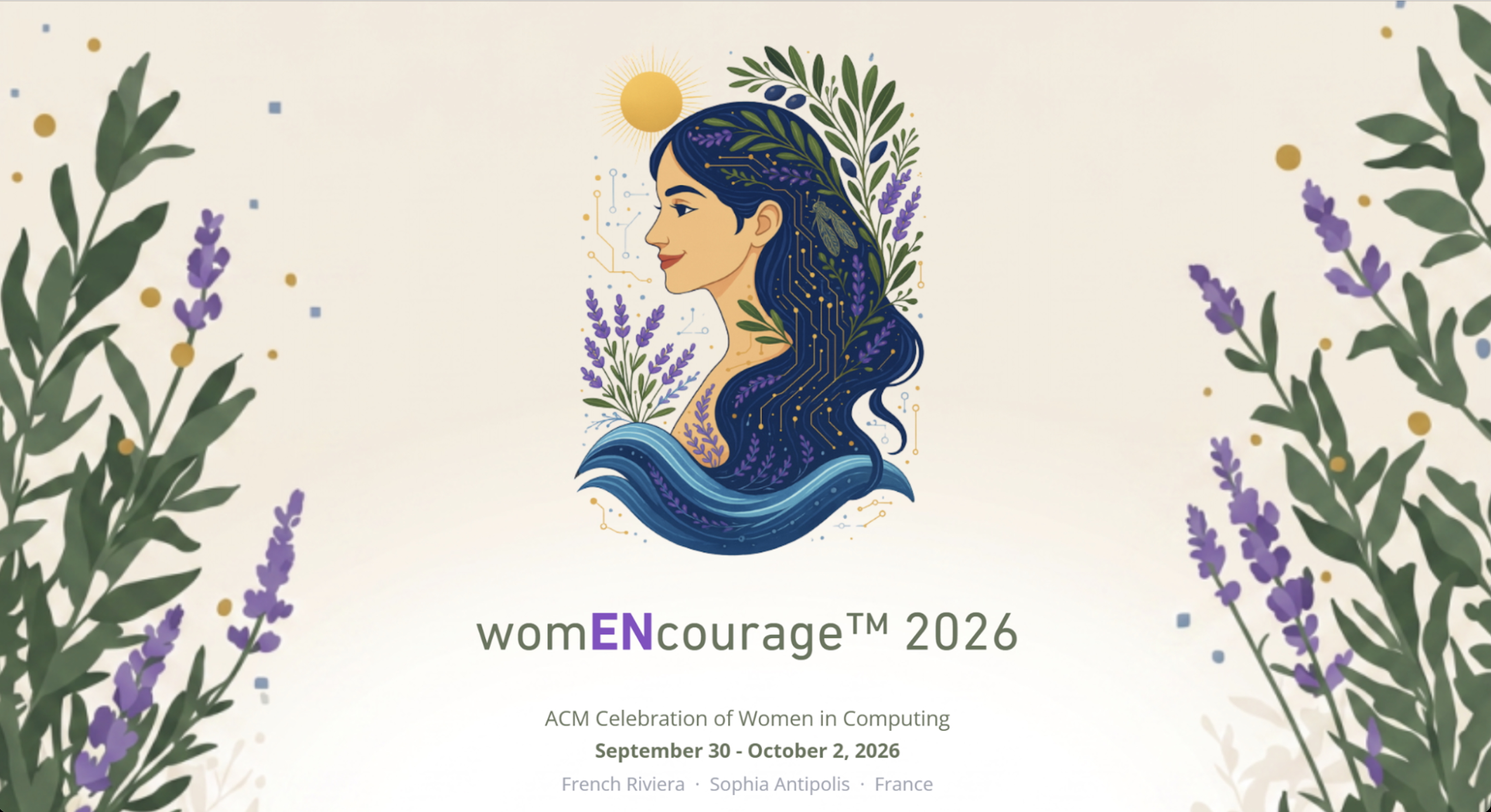
The French Riviera is known for its mountains, beautiful beaches, and turquoise waters. In September 2026, it became the setting for something beyond the usual holiday experience: WomENcourage, the annual conference celebrating women in computing.
I had the pleasure of participating for the first time, and the experience offered much more than technical talks and workshops. Over three days, I met women working on exciting projects, learned about new approaches to computer science education, and experienced what can happen when people are given the space to collaborate without feeling that they have to prove they belong.
Here are my highlights from WomENcourage 2026 in Nice.
Day 1: September 30, 2026. A Hackathon for Everyone.
For many participants, the first day marked their first-ever hackathon. Hackathons can be intimidating, particularly for women who have experienced the feeling that everyone else in the room knows more about programming than they do.
Imposter syndrome is familiar to many women in computer science. Walking into a room full of people who appear more experienced can make it difficult to contribute, even when you have valuable ideas of your own.
WomENcourage offered an environment in which participants could try something new, learn from each other, and build projects without the pressure of having to be the most experienced programmer in the room.
More than 20 teams participated in the hackathon, working under the theme of mental health and inclusion. The results were impressive in both their creativity and their practical ambitions.
This year’s winning project, Fail It Till You Make It, was a platform designed to encourage people to share their failures and normalize conversations about them. Other teams developed applications to help people disconnect from social media and plugins designed to support people with dyslexia.
The projects approached the same broad challenge from different directions. Some focused on changing how we talk about failure, while others aimed to make technology more accessible or help people develop healthier digital habits.
What made the experience particularly special was the collaboration itself. My teammates and I met for the first time that morning, yet we were able to work together toward a shared goal. We even decided to continue developing our project beyond the hackathon.
That, to me, was one of the most valuable outcomes of the day. A hackathon is not only an opportunity to build something in a limited amount of time. It can also be the starting point for friendships, professional relationships, and projects that continue long after the event ends.
WomENcourage created the conditions for all three.
Day 2, 01.October: Workshops, an Eye-Opening Keynote and a Gala Dinner
The second day brought together research, education, networking, and discussions about the future of computing.
Designing Software That Actually Includes People
One of the highlights was the keynote by Felienne Hermans, a professor of computer science education whose work explores how people learn programming.
Her talk challenged a familiar assumption in computer science: that the most technically sophisticated solution is necessarily the best one.
In computing, we often celebrate complexity. We admire elegant algorithms, advanced architectures, and technically challenging implementations. But how often do we stop to ask whether the software is actually useful to the people who are supposed to use it?
Hermans illustrated this question through her work on Hedy, a programming language designed to help children learn programming gradually. Her work also draws attention to the barriers created when programming environments assume that everyone uses the same language and conventions.
Programming languages traditionally rely on English keywords and specific syntax. For someone unfamiliar with these conventions, even a simple programming exercise can become a language test before it becomes a computer science lesson.
The broader point was clear: if a person encounters a barrier when using technology, the problem is not always the person. Sometimes the technology itself needs to change.
We frequently talk about making computer science more inclusive, yet inclusion requires more than encouraging people to adapt to existing systems. It also means questioning the assumptions behind those systems and considering whose needs have been overlooked.
This is particularly important in education. Telling students that they simply need to learn English or catch up with everyone else may be an easy response, but it does not address the underlying design choices that make computing less accessible in the first place.
Hermans’ keynote was a reminder that accessibility and inclusion are not additions to good software engineering. They are part of designing software that serves people well.
Learning From Women in Computing
The keynote was followed by a panel discussion featuring four successful women in computing. Their experiences offered another opportunity to reflect on careers, representation, and the challenges women continue to encounter in the field.
Representation matters because it changes what people can imagine for themselves. Seeing women succeed in different areas of computing makes it easier to recognize that there is no single path into the discipline and no single profile of what a computer scientist should look like.
For students and early-career researchers, hearing directly from women who have navigated the field can make professional ambitions feel more attainable. It also creates an opportunity to discuss challenges that are sometimes difficult to address in environments where women remain underrepresented.

Workshops: From Quantum Computing to More Inclusive Education
The workshop programme offered a diverse selection of topics, from quantum computing to social robotics and strategies for making computer science education more inclusive.
I spoke with workshop organizers to learn more about their work and the ideas behind their sessions. Three themes particularly stood out to me.
Quantum computing needs strong communities.
The workshop Quantum for All: Let’s Build the Future with Women highlighted the importance of building communities around emerging technologies. Technical expertise is essential, but so are the networks through which people share knowledge, support one another, and find opportunities to participate.
When a field is still developing, there is an opportunity to shape not only its technical direction but also its culture. Strong communities can help ensure that women are part of that process from the beginning.

Computer science education should not assume that everyone starts at the same level.
Imagine walking into a programming class where several students have already spent years experimenting with Python, while you are encountering your first line of code. Even if everyone is technically enrolled in the same course, they are not starting from the same position.
For students who already feel that they do not belong in computer science, this gap can reinforce the impression that the subject is not for them.
One interesting approach discussed in the context of computer science education was to begin with theoretical computer science before moving into programming. When students start with unfamiliar concepts that everyone must learn, prior programming experience becomes less of an immediate advantage. Everyone has an opportunity to build knowledge together.
The idea is not that programming should be avoided or that theoretical computer science is automatically the best starting point for every student. Rather, educators should consider how the order in which they introduce concepts affects students with different backgrounds.
A course can unintentionally reward prior exposure instead of measuring how well students learn.
Female role models should be part of the classroom.
Another important topic was how to make programming courses more appealing and help students recognize themselves in the discipline.
Introducing students to women who have contributed to computer science is one way to do this. Figures such as Grace Hopper, Kathleen Booth, and modern educators and computer scientists such as Felienne Hermans offer different examples of what a career in computing can look like.
Role models should not be limited to a single lesson about women in technology. Their work can be incorporated into the ordinary teaching of programming languages, algorithms, computer architecture, and the history of computing.
This helps make women’s contributions visible as part of the discipline itself, rather than treating them as a separate topic.
Discovering Research at the Poster Session
Throughout the day, participants could also visit the poster session, where young researchers presented their work.
Poster sessions are a valuable part of academic conferences because they offer a more direct way to engage with research. Instead of listening to a presentation from the audience, visitors can ask questions, discuss methods, and learn about projects in an informal setting.
The international range of research on display was another reminder of how many different questions are being explored within computer science and how important it is to create opportunities for early-career researchers to share their work.

There was also an opportunity to visit stands from ACM-w-Europe and the University of Southampton.

An Evening by the Mediterranean
The day ended with the gala dinner at La Siesta, right by the beautiful beach of Nice.
After a full day of talks and workshops, the evening offered time to relax, enjoy good food and music, and continue conversations outside the conference rooms.
Academic conferences are often described in terms of their scientific programmes, but informal encounters can be just as valuable. A conversation over dinner can lead to a new collaboration, a different perspective on a research question, or simply a connection with someone who shares your interests.
The gala dinner brought the second day to a fitting close.

Day 3 02.October: New Perspectives and the Grand Finale
The final day of WomENcourage continued with workshops and two keynote talks, offering more opportunities to exchange ideas and explore different areas of computing.
One workshop focused on networking for women, creating space to exchange experiences, ideas, and practical strategies for building professional relationships. Networking can be particularly important in fields where access to informal professional networks influences opportunities, visibility, and career development.

Discussing these experiences openly helps turn networking from an individual responsibility into something people can approach collectively. Participants can learn from one another, share useful practices, and build relationships that extend beyond the conference.
Another workshop, dedicated to social robotics, offered a practical introduction to developing use cases for social robots. It was an opportunity to think about how robotic systems might be applied in social contexts and what needs to be considered when designing technology that interacts with people.

Together, these sessions demonstrated the breadth of WomENcourage. The conference was not limited to one technical specialism or career stage. It brought together people interested in research, education, emerging technologies, and the social implications of computing.
The final day concluded the conference, bringing three days of learning, discussion, and networking to an end.
The Grand Finale
A raffle, prizes, reflections, and the big reveal: WomENcourage 2027 will be in the historic city of Istanbul.
More Than a Conference
Looking back at my first WomENcourage experience, what stands out most is the combination of technical curiosity and community.
The hackathon demonstrated how quickly people can begin collaborating when they are given a shared challenge and a supportive environment. The keynote showed why inclusive design requires us to question established assumptions about technology and its users. The workshops highlighted practical ways to make computer science education more accessible, strengthen professional communities, and explore emerging fields.
These experiences also raised a broader question: what would computer science look like if inclusion were treated as a fundamental part of the discipline rather than an additional objective?
It would mean designing software with a wider range of users in mind. It would mean teaching students without assuming that everyone arrives with the same background. It would mean making women’s contributions visible and creating communities in which people can participate without first having to prove that they belong.
Of course, a conference alone cannot solve the structural challenges women face in computing. But it can create the connections, ideas, and opportunities that help people work toward change.
For me, WomENcourage 2026 was an introduction to a community that values both technical innovation and the people behind it. I left Nice with new connections, new perspectives, and a project that my team intends to continue developing.
And that may be the most important thing a conference can offer: not just three days of inspiration, but reasons to keep working together after everyone has gone home.