

Is diversity in HPC still just a buzzword?
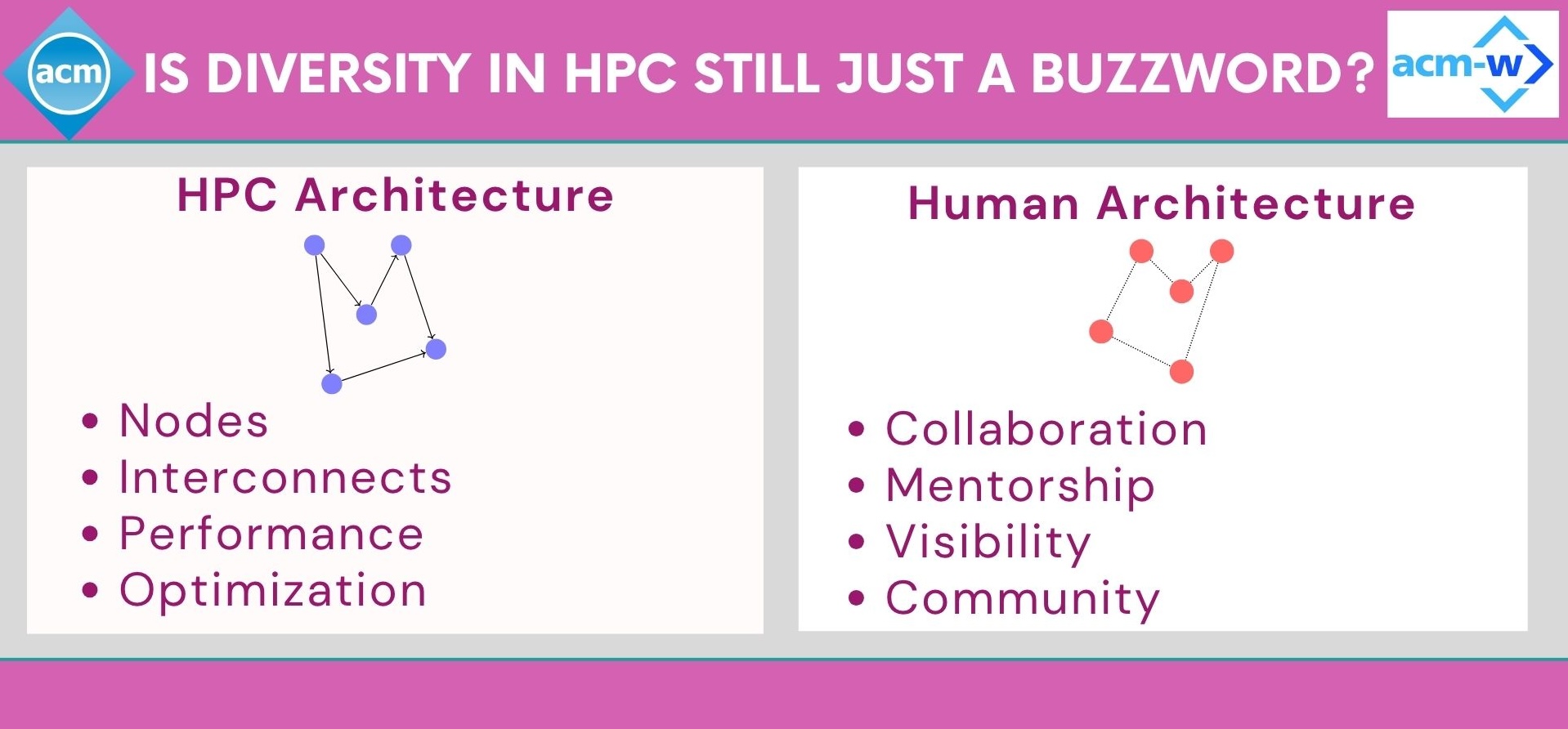
“Research Spotlights in Computing” is a technical blog series by ACM-W Europe Team Member Ayesha Afzal, highlighting contemporary work across computing research, with a focus on systems, tools, methods, and ideas developed by women in the field. This first blog anchors the series by introducing a systems lens that parallels human and computational architectures. The second blog will focus on student-facing guidance, exploring how to navigate within imperfect environments. From the third blog onward, the series will present case studies of technical innovations and research contributions led by women role models.
Is diversity in HPC still just a buzzword?
In this blog, Ayesha reflects on how HPC systems thinking can offer a useful lens for understanding inclusion, visibility, and participation in computing communities.
HPC conferences often feel like two realities sharing the same room.
On one side: extreme precision: distributed systems, scalability models, performance graphs, optimisation strategies.
On the other: a quieter imbalance: who is in the room, who speaks, and who is missing.
Everything in HPC is optimised… except the human system behind it.
That contradiction leads to a simple question:
Is diversity in HPC still just a buzzword or the one system we have not learned to optimise?
1. The uncomfortable mirror: systems vs communities
HPC runs on distribution. Problems are split, sent across nodes, and recombined with precision.
Communities mirror this structure.
People are the nodes: students, mentors, researchers, organisers, volunteers.
But disconnected nodes do not fail loudly; they slowly stop mattering.
2. When “efficient” systems still fail
In HPC, a single bottleneck degrades performance.
In communities, bottlenecks look like:
- you had to know someone
- this opportunity was never visible
- mentorship depends on luck
Conferences try to reduce this friction through high-bandwidth interaction, but:
bandwidth is not the problem; access is.
3. Parallel systems, unequal threads
HPC is built on parallelism: many processes, one outcome.
Careers in HPC are also parallel: research, publishing, teaching, networking, surviving.
But human systems do not self-balance.
Instead:
- visibility accelerates some paths
- silence slows others
- momentum compounds where it already exists
And this imbalance is often treated as normal behaviour.
4. When systems start to diverge: a modelling perspective
This intuition can be made more explicit through a simple systems model.
If team composition is interpreted as the number of perspectives in a system, and innovation speedup as output efficiency, two patterns emerge:
Homogeneous systems scale quickly but hit a saturation point where ideas reinforce rather than expand.
Diversity-optimised systems may introduce initial coordination cost but avoid early saturation by expanding the solution space.
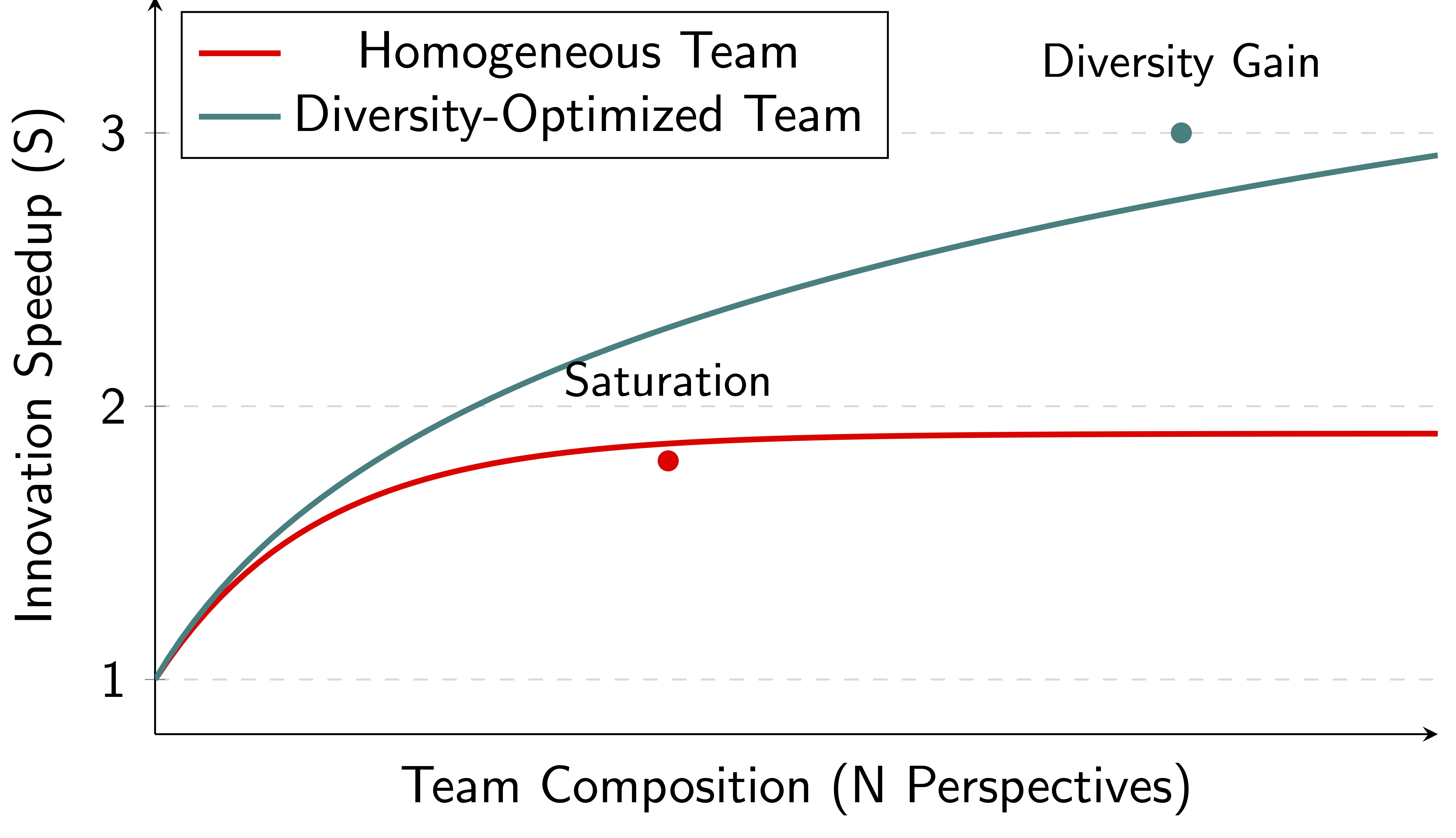
The curve shows a clear divergence: homogeneous systems saturate early, while diverse systems continue to grow in effective output.
Homogeneity optimises for alignment. Diversity enables exploration.
This is where “diversity gain” appears, not as a social metric, but as a structural effect: exposing blind spots and avoiding local optima.
5. The myth of self-healing communities
In computing, systems are debugged and redesigned.
In communities, there is often an assumption that inclusion improves naturally.
It does not.
Because real bottlenecks are structural:
- invisible networks
- uneven mentorship scaling
- limited entry points into visibility
And unlike compute systems, these are not logged.
They are visible when people leave.
6. Diversity is a system property
Diversity is not a value layered onto a system.
It behaves like performance:
- shaped by architecture
- constrained by connectivity
- limited by bottlenecks
- amplified by design
If the system is poorly designed, diversity does not fail; it cannot scale.
7. So what does fixing look like?
Not awareness. Not intent.
Design.
The same questions apply as in HPC:
- Where are the bottlenecks?
- What limits scaling?
- Which nodes are isolated?
- Who carries a disproportionate load?
Conferences are network layers.
Mentorship is load balancing.
Visibility is throughput.
8. Final thought
We would not call a system well-designed if it collapses under scale or ignores bottlenecks.
So the question is not whether diversity in HPC is a buzzword.
It is this:
Why are we still treating the human system as if it does not require engineering?

Ayesha Afzal is a researcher at the Erlangen National High Performance Computing Center (NHR@FAU), Germany. She holds a PhD in Computer Science, an MSc in Computational Engineering, and a BSc in Electrical Engineering. Her PhD, “A Holistic White-Box Approach to Performance Modeling for Supercomputing,” focuses on analytic performance models, performance tools, and parallel simulation frameworks in HPC. She is involved in HPC initiatives including KONWHIR (LRZ), DFG MOD4COMP (TU Dresden and Jülich), and the NHR EEC (NHR centers). Within the IEEE Computer Society, she serves as Vice Chair of both the Germany Section Chapter and Region 8 Area 2, and Secretary of IEEE TCHPC. She founded the NHR Women in HPC chapter and organizes workshops at international conferences (SC, ISC, ACM HPDC, and SCA/HPCAsia). She is a member of professional societies (ACM, IEEE, SIAM, and PRACE), and contributes as chair, vice chair, PC member, Journal reviewer, panelist, and speaker. She has authored numerous peer-reviewed publications, and her work has been recognized through distinctions: ISC PhD Forum Award (1st place, 2021), IEEE TPDS Best Paper Runner-up Award (2023), SC PMBS Best Short Paper Award (2023), SC Best Research Poster Finalist (2024), ISC Best Research Poster Award (1st place, 2025) and PhD with highest distinction (summa cum laude). She was listed among the Top 100 Future Leaders Role Model List (2022–2025) supported by Yahoo Finance and YouTube, and received WeAreTheCity’s Global Award for Achievement (2023).