

Hidden Structures in Modern Computing: Emmy Noether
“Research Spotlights in Computing” is a technical blog series by ACM-W Europe Team Member Ayesha Afzal, highlighting contemporary work across computing research, with a focus on systems, tools, methods, and ideas developed by women in the field. The first blog anchored the series by introducing a systems lens that parallels human and computational architectures. The second blog focused on student-facing guidance, exploring how to navigate within imperfect environments. From this third blog onward, the series will present case studies of technical innovations and research contributions led by women role models.
In this third installment, Ayesha connects abstract mathematics, theoretical physics, and modern computing by exploring the monumental work of Emmy Noether, a foundational genius whose legacy reshaped modern science and continues to influence the ways we understand complex systems today.
A Personal Beginning: The Streets of Erlangen
Choosing Emmy Noether as the first case study in this series is intentional. She embodies this series’ core idea: progress comes not from more computation, but deeper understanding.
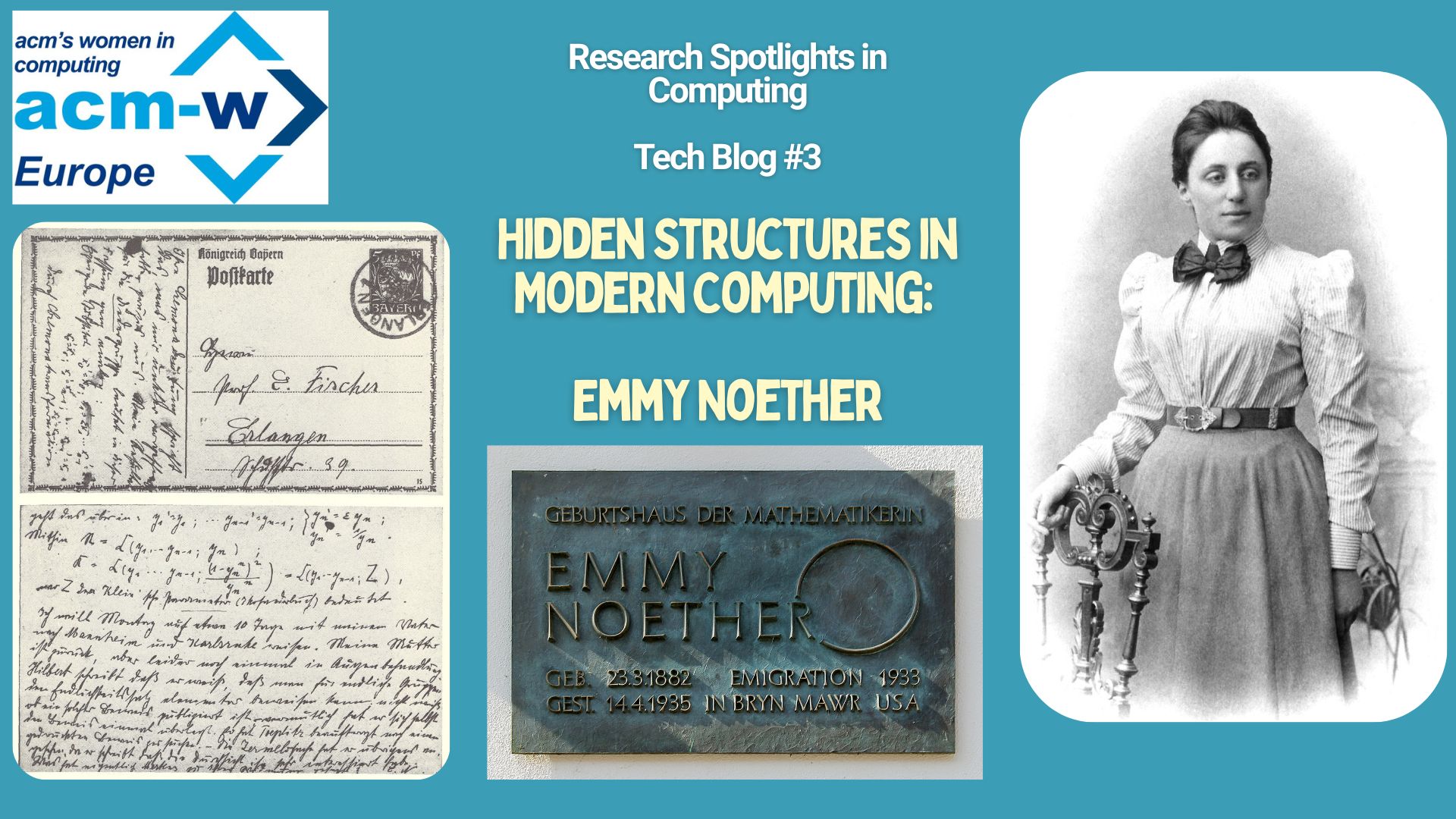
Every morning, as I walk through Erlangen, Germany, and step into my office at Friedrich-Alexander-Universität Erlangen-Nürnberg (FAU), I am reminded that modern scientific thought was fundamentally reshaped on these grounds. Emmy Noether was born here in 1882 into a mathematics-oriented family. Her father, Max Noether, was a professor at the same university where I later completed my PhD. Although initially encouraged to pursue language teaching in French and English, she chose mathematics instead. She was one of just two women among 986 students at FAU at the time. She completed her doctorate in 1907, when women were still largely excluded from academia. She later worked in Göttingen, attending lectures by Hilbert, Klein, Minkowski, and Schwarzschild, and continued in unpaid and often informal roles. She also lectured in place of her father, while her ideas began reshaping mathematics.
“The most significant creative mathematical genius thus far produced since the higher education of women began.”
— Albert Einstein on Emmy Noether
Noether school: A Reimagined Approach to Teaching
Noether developed a highly interactive teaching style at Göttingen. Her seminars were collaborative: students actively contributed ideas, worked through problems publicly, and developed arguments alongside her rather than passively receiving finished lectures. This fostered a close intellectual community often called the “Noether school.” Her teaching reflected her mathematical outlook, emphasizing structural thinking and conceptual relationships. Learning was treated as a shared process of discovery rather than one-way transmission of results. This created the “Noether school” and a lasting philosophy:
Understanding emerges through participation, not transmission.
Beyond the “Jungle of Formulas”
Noether changed not just what problems we solve, but how we think about them. Early 20th-century mathematics, especially invariant theory, relied heavily on explicit symbolic computation. In her early work in Erlangen, she worked within this computational tradition before later helping to transform it. She moved from calculation to structure, focusing on relationships and algebraic frameworks rather than explicit formulas. Historians often contrast this shift with the earlier “computational” style of invariant theory. This transition toward structural thinking became a foundation of modern abstract algebra and influenced later developments in mathematics that also underpin areas of theoretical computer science. Instead of focusing on specific answers, her work emphasizes a structural question:
Noether’s Theorem: Symmetry as Law
In 1918, she published one of the most important results in theoretical physics. Emmy Noether’s theorem links symmetries of physical systems to conservation laws and remains foundational in modern physics. Conservation laws arise from symmetry:
What once looked like separate physical laws is now understood as a single structural principle. More than a century later, Noether’s theorem remains central to quantum field theory, particle physics, and gauge theories.
Beyond Physics: Structural Algebra
Noether also transformed algebra by shifting focus from computation to structure through objects such as rings and ideals. She introduced the Ascending Chain Condition (ACC), defining what we now call Noetherian rings. For a chain of ideals:
I₁ ⊆ I₂ ⊆ I₃ ⊆ …
Noether showed that in a Noetherian ring, this sequence must stabilize:
Iₖ = Iₖ₊₁ = …
This principle provides a powerful way to control mathematical complexity. Her structural viewpoint influenced modern algebra and underpins areas such as cryptography, coding theory, symbolic computation, and formal methods.
The Parallel: From Algebra to Modern Computing
As an HPC researcher working on white-box performance modeling for supercomputing, Noether’s thinking feels strikingly familiar. Modern systems are overwhelmed by complexity: hardware counters, communication costs, runtime variation, and software stack interactions. Raw measurement alone is insufficient. We instead look for structure.
- We model relationships between algorithms, architecture, and performance rather than relying only on empirical data.
- Many simulations must preserve symmetries and conservation laws to remain stable and accurate.
- Distributed algorithms require guarantees about bounded progress and termination, reflecting structural reasoning about system behavior.
Across all of this lies a shared question:
What remains invariant when everything else changes?
That is where understanding emerges.
Living Legacy
Noether changed not just mathematics and physics, but how they are understood. Her legacy is clarity: understanding begins not with complexity, but with structure; not with more computation, but with what endures when everything shifts. Her legacy today lives on through:
-
- DFG Emmy Noether Programme
- AWM Noether Lecture
- Emmy Supercomputers at FAU/RRZE Erlangen and HLRN Berlin–Göttingen
- Emmy Noether Institute at FAU and Bar-Ilan universities
- Emmy Noether distinction in mathematics and related fields
- Various Noether fellowships and visiting professorships worldwide
Noether’s work helped shift mathematics from computational, formula-heavy approaches in invariant theory toward a focus on underlying structures and relationships.

Dr.-Ing. Ayesha Afzal is a researcher at the Erlangen National High Performance Computing Center (NHR@FAU), Germany. She holds a PhD in Computer Science, an MSc in Computational Engineering, and a BSc in Electrical Engineering. Her PhD, “A Holistic White-Box Approach to Performance Modeling for Supercomputing,” focuses on analytic performance models, performance tools, and parallel simulation frameworks in HPC. She is involved in HPC initiatives including KONWHIR (LRZ), DFG MOD4COMP (TU Dresden and Jülich), and the NHR EEC (NHR centers). Within the IEEE Computer Society, she serves as Vice Chair of both the Germany Section Chapter and Region 8 Area 2, and Secretary of IEEE TCHPC. She founded the NHR Women in HPC chapter, is elected women representative at the FAU, and organizes workshops at international conferences (SC, ISC, ACM HPDC, and SCA/HPCAsia). She is a member of professional societies (ACM, IEEE, SIAM, and PRACE), and contributes as chair, vice chair, PC member, Journal reviewer, panelist, and speaker. She was listed in the SCW75 list (2026), in the Top 100 Future Leaders Role Model List (2022–2025), supported by Yahoo Finance and YouTube, and won WeAreTheCity’s Global Award for Achievement (2023). She has authored numerous peer-reviewed publications, and her work has been recognized through distinctions: ISC PhD Forum Award (1st place, 2021), IEEE TPDS Best Paper Runner-up Award (2023), SC PMBS Best Short Paper Award (2023), SC Best Research Poster Finalist (2024), ISC Best Research Poster Award (1st place, 2025) and PhD with highest distinction (summa cum laude, 2026).