

Programming Before Computers Existed: Ada Lovelace
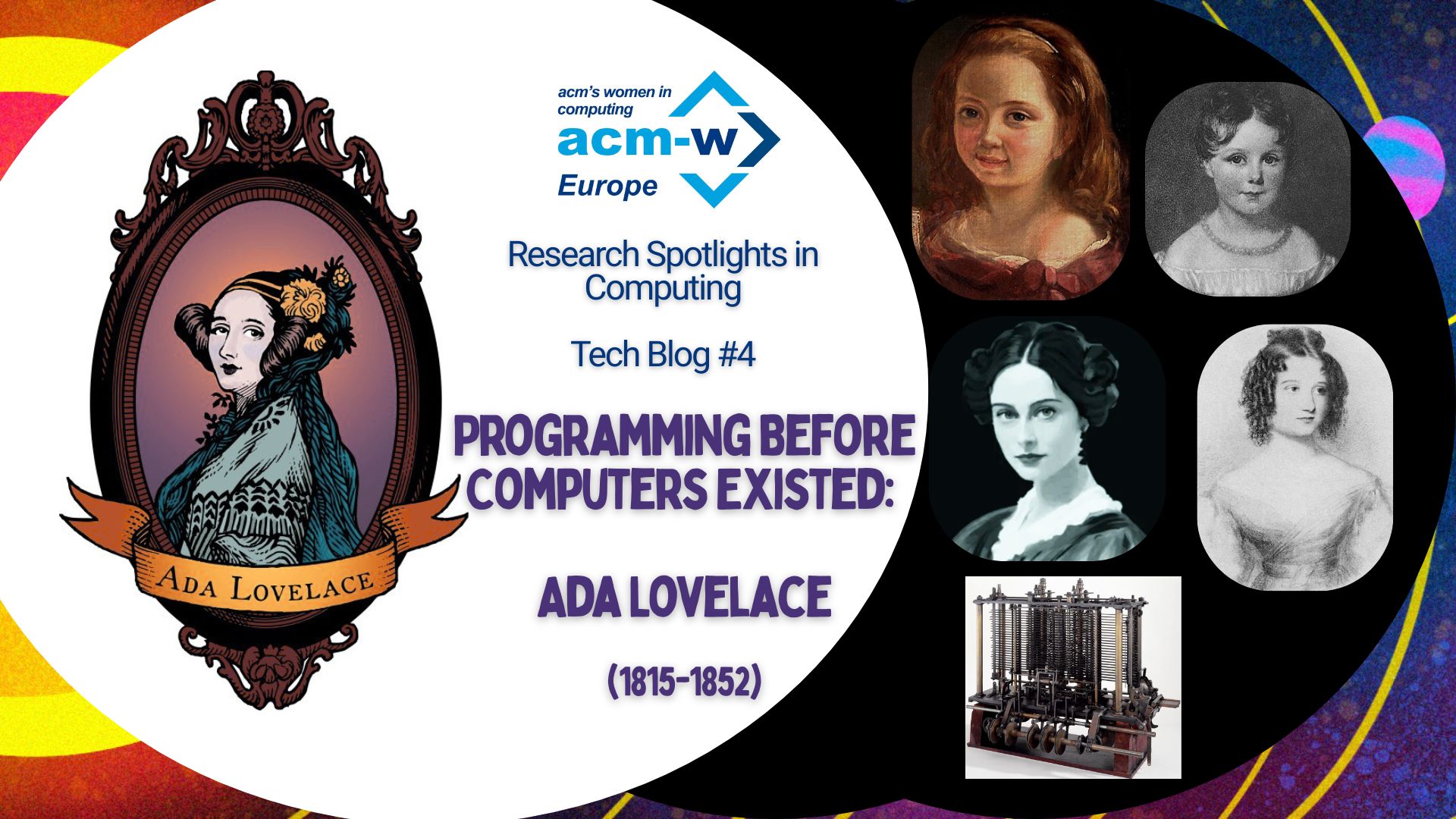
“Research Spotlights in Computing” is a technical blog series by ACM-W Europe Team Member Ayesha Afzal, highlighting contemporary work across computing research, with a focus on systems, tools, methods, and ideas developed by women in the field. The first blog anchored the series by introducing a systems lens that parallels human and computational architectures. The second blog focused on student-facing guidance, exploring how to navigate within imperfect environments. The third blog opened the series’ case studies with Emmy Noether. This fourth blog continues that arc with Ada Lovelace.
In this fourth installment, Ayesha traces how a nineteenth-century mathematician, working from notes on a machine that was never built, articulated an idea that still organizes how we think about software today: that a machine and the ideas it carries out are not the same thing.
Seeing Beyond the Machine
Every computing revolution starts with the same question: what could a machine become, if we looked past what it was built to do? Nearly two centuries ago, Ada Lovelace became the first person to articulate in print that a machine could be far more than a calculator—that its true power lay in the instructions it could execute.
My own work lives in an in-between place. I rarely design hardware; instead, I translate what a machine actually does into something developers can reason about. Building something and understanding it are not the same skill.
I think about that gap whenever I return to Ada Lovelace, who lived a starker version of it. Born in London in 1815 to Lord Byron and mathematician Anne Isabella Milbanke, she was steered toward mathematics from childhood. In June 1833, her tutor Mary Somerville introduced the seventeen-year-old to Charles Babbage, who was then demonstrating a working section of his Difference Engine. Babbage conceived his more ambitious design shortly after — the Analytical Engine, a mechanical general-purpose computer, decades before electricity would make one practical.
The Idea of Programming Before Programming Existed
Babbage never secured funding to build it. What he had, by 1842, was a French paper on it by Luigi Menabrea. He asked Lovelace to translate it into English.
She did more. Alongside the translation, she added her own notes, labeled A through G — three times the length of Menabrea’s original. Of the sixty-odd published pages, most were hers. A translation job became one of the foundational texts in the history of computing, because she refused to stop at conversion.
That moment captures something fundamental about research: the most valuable contributions often emerge when someone looks beyond the assigned task and asks what else is possible.
Understanding a machine well enough to translate it can mean understanding it better than the person who built it.
Beyond Calculation
In Note A, Lovelace made the observation that still defines what a computer is:
“We may say most aptly that the Analytical Engine weaves algebraical patterns just as the Jacquard-loom weaves flowers and leaves.”
— Ada Lovelace, Note A in Sketch of the Analytical Engine Invented by Charles Babbage, 1843
Lovelace argued that computation need not be limited to arithmetic. If symbols could represent relationships according to formal rules, then a machine could manipulate those relationships just as readily as numbers. Numbers happened to be the first symbols available. That shift in perspective is what separates a calculator from a general-purpose computer.
She also worked out, in the same notes, how the engine itself would carry that idea structurally:
- The Store — memory columns holding numbers
- The Mill — the arithmetic core
- Control — operation cards and variable cards, using punched-card concepts adapted from the Jacquard loom to specify instructions and data
It was not the modern stored-program architecture, but the underlying instinct — separating what operation to perform from the data on which it operates — is one that continues to shape computing today.
Note G: An Algorithm for a Machine That Didn’t Exist
Note G laid out, step by step, how the engine would compute Bernoulli numbers — a sequence that’s notoriously awkward by hand because each term depends recursively on all the ones before it. Twenty-five computational steps, fully specified: variables, sequencing, reused intermediate results. It’s why Note G is widely regarded as the first published computer program — for hardware that existed only on paper.
A Researcher Ahead of Her Time
Babbage’s own 1864 memoir describes the division of work clearly: he provided the underlying mathematical formulation for the Bernoulli number calculation, while Lovelace developed the detailed sequence of operations needed to express that calculation for the Analytical Engine. In doing so, she went beyond translation and demonstrated how a machine could execute a general procedure.
That distinction matters. Computing has always advanced through a combination of invention, interpretation, and abstraction — not only by building machines, but by understanding what those machines make possible. This is one reason why this series exists: to highlight the people whose insights, methods, and ideas shape computing, often beyond the boundaries of a single invention.
The Parallel: Software as Its Own Layer
The distinction Lovelace drew — between the engine and what it could be instructed to do — is one researchers rediscover constantly, in a different vocabulary:
Every time we port code to new hardware without rewriting the algorithm, we lean on the separation she was first to describe in print.
Living Legacy
Lovelace’s story is more than an anecdote about a poet’s daughter with a flair for numbers. It is the record of someone who explained, more clearly than anyone else of her time, what that unbuilt machine could ultimately become. Her name persists through:
- The Ada programming language, named in her honor
- NVIDIA’s Ada Lovelace GPU architecture, powering today’s AI hardware
- Ada Lovelace Day, held annually in October
- Association for Women in Computing’s Ada Lovelace Award
- BCS Lovelace Medal, awarded by the British Computer Society
- PRACE Ada Lovelace Award for HPC
Lovelace’s contribution was not a working machine. It was the recognition that a machine’s capabilities and the instructions it executes are distinct, and that this distinction lies at the heart of modern computing.