

Empowering the community by Anna Szlávi
 Anna Szlavi (she/her) is a researcher at the Department of Computer Science at the Norwegian University of Science and Technology in Trondheim, Norway. She was a Fulbright Researcher at the University of Pennsylvania, in the USA, and got her PhD at Eotvos Lorand University, in Hungary. She has been the Vice-Chair of the ACM-W Trondheim Chapter since 2022. Anna is also a WP Leader in the Women STEM Up EU-project, specialized in making STEM education more gender-inclusive through setting up the Leadership and Inspiration Academy and a mentorship program for women students in STEM. She was in the leadership group of the EU project EUGAIN (European Network for Gender Balance in Informatics), creating interventions for girls and women in IT all around Europe. In addition to leading EU-level projects about gender inclusion in tech, Anna has given lectures, presentations, and workshops on DEI, gender-inclusive language, and inclusive design all around the world. In 2025 she was nominated for the DigIT “Woman of the Year in Tech” Award and the Nordic Women in Tech Award as the DEIB Champion of the Year.
Just a couple of weeks ago, on April 24th 2025, we celebrated the “Girls in ICT Day”. Why have such a day at all, some asked me. Usually, I let the numbers speak: only 23% of STEM majors are girls, and only 16.5% of ICT majors are women. In other words, girls are underrepresented in ICT. In this article, let me walk you through some of the main questions that may come up about the topic and how you can address them.
Why is it a problem that there are few girls in ICT?
The fact that few girls choose ICT as their study path leads to a very homogeneous workforce in the ICT sector, which in turn results in a lot of technological mistakes, or “bugs”, including in the development of AI. This is how, for example, images like the one below, generated by OpenAI in response to the question to depict 4 software developers, can be generated. There is not a single woman in the picture. And of course, it’s depressing, or comical depending on your point of view, that the figures are almost copy-pastes of each other – in terms of hair, facial hair, glasses, and clothing. (Not to mention that the number doesn’t match either.) It is not hard to conclude that this is not an ideal team of developers when we need diverse viewpoints and creative discussions to develop solutions that work well for many.

Open AI’s image of ‘4 software engineers’ – Courtesy of Letizia Jaccheri, chair of ACM’s womENcourage conference 2023
It is even more problematic that bias leads to bugs also in facial recognition software. While they work almost perfectly for white men, they are 34.4% less effective for recognizing women, especially black women. Joy Buolamwini, widely known for her TED talk popularizing intersecting biases in AI, illustrates this imperfection vividly in her video about AI’s misrepresentation of historical and contemporary African-American role models below.

Joy Buolamwini – Ain’t I a Women?
Such technical issues underline the pressing issue of approaching diversity, equity, and inclusion (DEI) through an intersectional, i.e. a more nuanced approach. It has been my mission to bridge social sciences – and terms like intersectionality – with computer science, for this same reason. Our literature review on the status of intersectionality research within computing concluded with a call for a better integration of the concept in ICT, and our design research on an intersectional peer networking solution reveals the importance of thinking beyond the gender dimension solely when attempting to solve the diversity crisis in ICT.
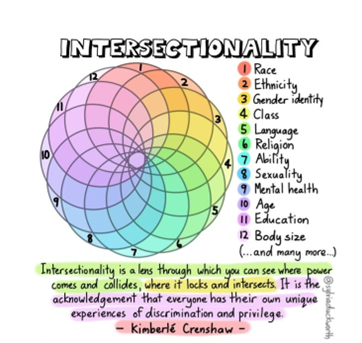
Intersectionality (Crenshaw, 1989) – diagram by Duchworth (2020)
What’s stopping girls from choosing ICT?
Often, I hear people say that women are just not interested in ICT, and that’s as simple as that. Having researched the topic for years, I think it is much more complex. One of the key objectives of our project EUGAIN (European Network for Gender Balance in Informatics) was exactly to find out the complex reality of what keeps girls from choosing ICT as a career. Headed by ACM-W co-chair Rukiye Altin, our multiple-year-long study, mapping 155 studies, came up with identifying 8 different barriers and 8-10 sub-categories within each category. It would be too long to analyse them all in detail here, so I will only mention one example for each category.
- Public: The media portrays STEM, including ITC, as a boy’s field.
- Familial: There is a strong belief that the primary responsibility of women and girls is the family, and that a career in ICT is incompatible with the female identity.
- Physical: If there is a computer in the family, it is typically not the daughter’s, but primarily the son’s. Consequently, girls come to school with less ICT experience and/or interest.
- Educational: Many girls have unpleasant experiences in ICT classes because some of the teachers internalize that STEM subjects are not for girls, which influences their behaviour towards their female pupils.
- Political: Official career guidelines often orient girls in a different career direction.
- Social: There are very few (visible) female role models in ICT, so it is difficult for girls to imagine themselves succeeding, so they do not prioritize this direction on their own.
- Belief-based: Internalizing the above social-educational-political influences, most girls do not think they are good enough in the field, so they don’t even try it.
- Economic: Last but not least, girls are less motivated towards ICT careers because women’s salaries are still much lower than men’s even within the same position.
You can read more about the above barriers, broken down into the different stages of the career cycle, in these publications.
How can we help increase gender balance in ICT?
Fortunately, there are many tools we can use to make ICT more diverse. For example, it’s very important to provide girls – and their teachers – with role models. It is a powerful experience for high school students to interact with an adult who they can identify with (because she is a woman, for example) and look up to (because she is enthusiastic and/or successful). Young people can be deeply impressed by someone who can tell them in an authentic and inspiring way what they like about a career in ICT. But it is also crucial later in one’s studies and even career to meet relatable role models who can remind them that they belong.
Belonging, as well as being appreciated for one’s uniqueness, are important conditions that help one to stay in a field where one is in a minority, such as women in ICT.
While personal encounters are typically the most inspirational, arranging such events can also be costly or logistically challenging. This is what our Women STEM Up European collaboration project has tried to provide a remedy for. We collected the profiles of several dozen international role models, providing a video, a quote, and contacts, thus bringing them to anyone anytime anywhere. You can make your students look at them for inspiration during an ICT class or show them to your employees within the framework of your DEI initiatives.
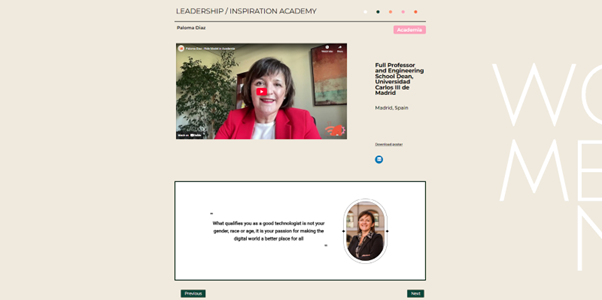
Role models in the Leadership and Inspiration Academy: Paloma Diaz, chair of ACM’s womENcourage conference 2024
In addition to role models, mentoring is also an effective way of attracting more girls into the field, as well as helping them to stay in ICT. The biggest challenge of running a mentoring program tends to be the lack of resources and the uncertainty of how to get started or whether to even do it. The Women STEM Up mentoring program, which started in November last year and targeted female university students studying computer science, has been a success. Our survey showed that even a shorter mentoring program can have a positive impact on girls’ self-esteem and enthusiasm for ICT. So the answer is yes: do it. But how, you may ask. Our article about mentoring, aimed specifically at increasing gender diversity, will be available in EUGAIN’s open access volume soon (Penzenstadler, B. et al. (Eds.) Actions for Gender Balance in Informatics Across Europe. Springer Nature). And while you are waiting, you can find practical guidelines for setting up a mentoring program and for training your mentors on the project’s site.
Finally, it is essential to add that DEI initiatives, whether in academia or the corporate world, are indispensable for sustainability. In the current political climate, more and more universities and companies cut, alter or question their dedication to diversity, equity, and inclusion, which is likely to have detrimental consequences for girls’ and women’s representation in ICT. It is alarming to see that our paper analyzing tech giants’ stance on inclusion in 2023 and a new analysis of these companies early 2025 (to be presented at ACM’s FSE conference in June 2025) paint quite different pictures. It is encouraging to see that ACM has reiterated its commitment and dedication to DEI and its women’s chapters. Diversity, equity, and inclusion should not be matters of political sides but our shared interests.