

ACM Scholar Spotlights: Yamilka Toca
Welcome to ACM Scholar Spotlights, a series where we shine a light on the inspiring paths of women in computing who received the 2024 ACM-W scholarship. Through their own words, we hear how they found their place in tech, what motivates them, and how they’re making an impact. These stories reflect not only technical achievement, but also courage, curiosity, and community.
In this post, we meet Yamilka Toca, a PhD student originally from Cuba, studying Systems and Informatics Engineering at the University of Zaragoza, Spain. Yamilka shares her powerful journey of perseverance and purpose in this interview-style reflection.
Introduction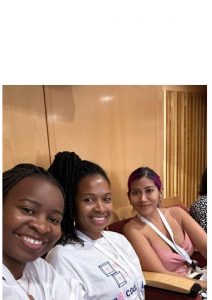
My name is Yamilka Toca, and I am from Cuba. I am a third-year PhD student in the Systems and Informatics Engineering program at the University of Zaragoza (Spain).
Background Info: What do you study? Why did you want to get into technology and this particular area? How would you like to progress in your career?
We all come into this world with a purpose, but sometimes, due to the disconnection between mind, body, and soul, we lose sight of it or veer off course. I am a computer engineer because today I should be writing these lines about it.
The only example of a professional role model I had in my family was an aunt who was a pharmacist. I remember that when I was eight years old, I used to go to the pharmacy with her, and one day I told her, “I want to make medicines.” My aunt dissuaded me with arguments that I didn’t fully grasp at the time, but looking back, I understand it boiled down to the low salaries in that profession during those days.
Later on, I aspired to be a brain surgeon or an advocate for the good people—those were my childhood terms for what neurosurgeons and lawyers do. I also dreamed of being a dancer. These desires faded for various reasons, possibly because while there was interest, there wasn’t passion.
What helped you get where you want to be?
I do not believe in coincidences; I consider that what some call luck is the result of the intersection between preparation and opportunity. I began to study Computer Engineering out of mere curiosity that arose due to events that conditioned my interest in the world of computers. This curiosity, coupled with a strong academic performance, granted me admission to the University of Computer Sciences in Cuba, which was inaugurated precisely in 2002 when I was to begin my university studies.
The passion for research and learning has continually motivated me to improve myself. Subsequently, I pursued a Master’s Degree in Technologies for Education, and currently, I am pursuing a PhD in Systems Engineering and Computer Science.
What skills have been valuable during your career?
If I had to describe the journey of my professional life up to this moment with one word, it would be perseverance. Accepting ‘no’ as an answer, but trying to turn myself into a yes has been my goal to follow. The fact that I am doing my PhD in Spain—an opportunity that involves a rigorous selection process—is a testament to my refusal to give up without exhausting every effort.
I applied for three consecutive years to the Santander scholarships. The first two times, I was not among the accepted candidates, but I kept improving myself and my curriculum. The third time, I managed to qualify for the selection.
I did not get discouraged or sad. I am one of those who believe that there are things in life that should come just when you are ready. If they come before, they fade away because you do not have the necessary wisdom to take advantage of them.
What do you enjoy most about your studies?
What I enjoy most about my studies is the diversity of career opportunities available, which allows me to apply my knowledge to the fields I dreamed of working in as a child. Nowadays, there is no conceivable field in which we cannot apply our knowledge of computer science.
Another notable aspect is that it allows us to develop and grow every day as professionals because it is a dynamic field that offers constant opportunities for learning and updating knowledge. This dynamic nature keeps the career both interesting and challenging.
Where do you think the biggest challenges and opportunities are for women wanting to make their mark in technology right now?
In my view, while opportunities do exist, there are significant challenges for women aiming to make their mark in the technology sector. Achieving greater access and visibility remains a major hurdle. Persistent issues such as the gender gap, stereotypes, and biases continue to hinder progress. Additionally, the lack of female role models and visibility in the field discourages girls and young women from pursuing careers in technology.
Events like WomEncourage offer valuable opportunities for women in computer science to connect and collaborate, fostering relationships that can lead to impactful collaborations. It underscores the collective task at hand: to cultivate and enhance the presence of women in technology.
What advice would you give to women considering following your path?
We must be bold—the only thing that can go wrong is what we never try. There are two quotes by Virginia Satir that I deeply resonate with:
-
“We must not allow other people’s limited perceptions to define us.”
-
“We can learn something new every time we believe we can.”
How have you dealt with moments of doubt, i.e., the ‘imposter syndrome’?
I once heard a phrase that has stuck with me: “No es lo que somos lo que nos limita, sino lo que pensamos que no somos” (“It is not what we are that limits us, but what we think we are not”).
I strive to remember that nothing happens by chance, and that there is purpose in being who I am. Each day, this purpose becomes clearer to me—to inspire and connect women.