

ACM-W Europe April 2026 Newsletter
In this issue:
- GEC 2026 Announces Its Keynote Speakers — and the Topics Are Worth Your Attention
- WomENcourage™
- The Story behind the womENcourage 2026 Logo
- Research Spotlights: Is Diversity in HPC Still Just a Buzzword?
- Cognitive Bias Series: When Ambiguity Works Against Women in Computing
- Stories of Women in Computing Matter
- Trailblazers in Computing: Wendy Hall
- Announcement’s
GEC 2026 Announces Its Keynote Speakers — and the Topics Are Worth Your Attention

Building on the success of seven summits, the 8th ACM Summit on Gender Equality in Computing (GEC 2026) is on the horizon — and the keynote lineup gives a strong preview of where the conversation is heading.*

AI that actually works for women. Dr. Nelly Bencomo (University of Durham, UK) will present weDecide, a decision-support tool for women’s health that combines machine learning with multi-criteria modelling. Her talk uses menopause as a case study to expose real gaps in how AI systems handle uncertainty, fairness, and underrepresented domains. This is applied AI research with stakes.
Creativity, collaboration — and a provocation. Dr. Dimitrios Grammenos (ICS-FORTH) asks what happens to diversity and inclusion when AI becomes a creative collaborator, not just a tool. His keynote doesn’t offer easy answers — it sparks the right questions about bias, authenticity, and what it means to create in an increasingly hybrid human-AI future.
Together, these two talks reflect exactly what GEC does best: grounding big technical questions in the realities of people who have too often been left out of the design process.
More details to follow. Watch this space.
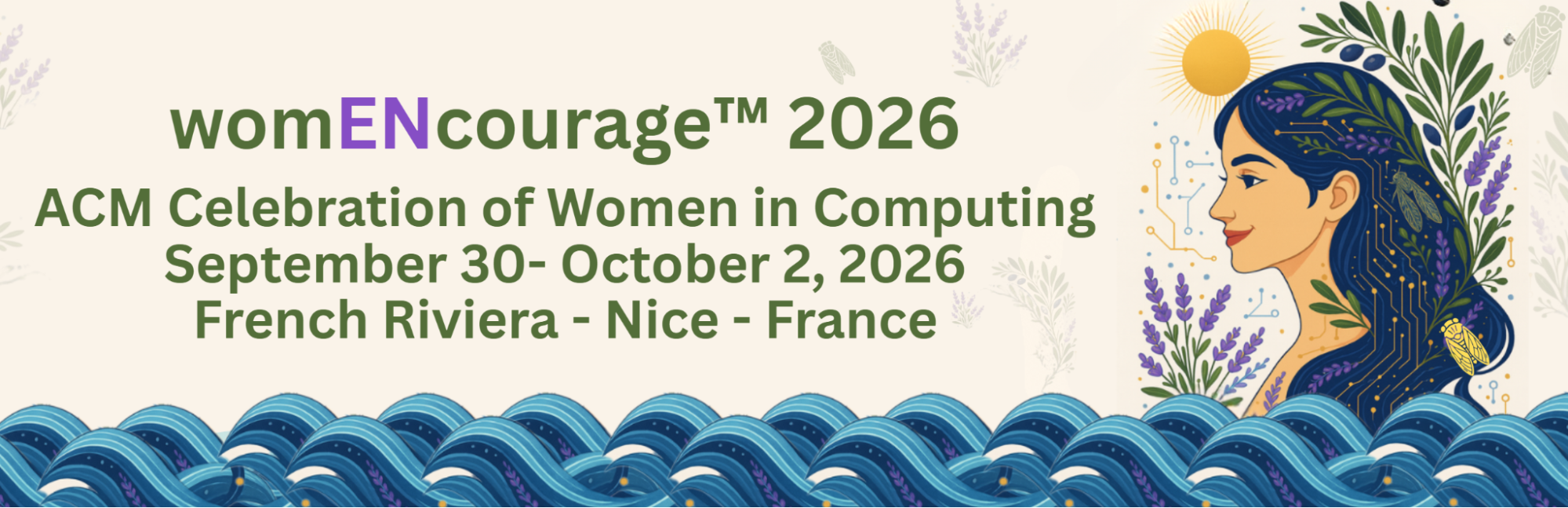
ACM womENcourage™ 2026 — Nice, France | September 30–October 2
Mark your calendars! The 13th ACM Celebration of Women in Computing is heading to Nice, Côte d’Azur, France, from September 30 to October 2, 2026. Set against the Mediterranean coastline, this year’s conference promises three days of learning, networking, and inspiration under the theme “Unmute Yourself, Grow Stronger Together. Listen to Your Inner Voice and Walk on Your Own Path for Well-being in Computing.”
The program will feature keynotes from leading voices in tech, hands-on workshops, a hackathon, and a poster session — something for students, researchers, and professionals alike.
Submit a Poster — Deadline: May 8, 2026
Step 1 : Prepare your extended abstract: Write a PDF document of no more than 2 pages in ACM format. It must include: title, authors’ names and affiliations, and a concise overview of your research.
Step 2 : Prepare your visual poster: Create an A1-format poster following the official template available on the conference website. Your poster should be visually compelling and reflect the title, authors, and key points of your abstract. You may also include QR codes linking to online materials.
Step 3 : Submit via HotCRP. Both PDF documents must be submitted together on the HotCRP platform, in English.
A few important reminders:
- Multi-author submissions (of any gender) are welcome
- You may present results already published elsewhere (no proceedings)
- An accepted poster significantly strengthens your womENcourage™ scholarship application
Propose a Workshop or Tutorial — Deadline: May 19, 2026
Educators, researchers, and industry professionals are encouraged to submit proposals for workshops or tutorials across all areas of computer science, particularly those aligned with the 2026 themes of well-being, inclusion, and sustainability in tech.
Registration is opening soon. Visit Association for Computing Machinery for full details and submission links.
The Story Behind the womENcourage 2026 Logo
Every detail of the womENcourage 2026 logo was designed with intention. From the circuit lines woven into a woman’s flowing hair, to the olive branches, lavender, cicadas, and Mediterranean waves at its base — the design tells the story of this year’s theme: “Unmute Yourself, Grow Stronger Together.”
Rooted in the landscape and spirit of Nice and the French Riviera, the logo brings together nature, regional identity, and technology into a single, cohesive image — one that reflects the conference’s core belief that human well-being and technical excellence are not in tension, but inseparable.
Read the full story behind the design and discover what each element represents.
Research Spotlights: Is Diversity in HPC Still Just a Buzzword?
By Ayesha Afzal, ACM-W Europe Volunteer
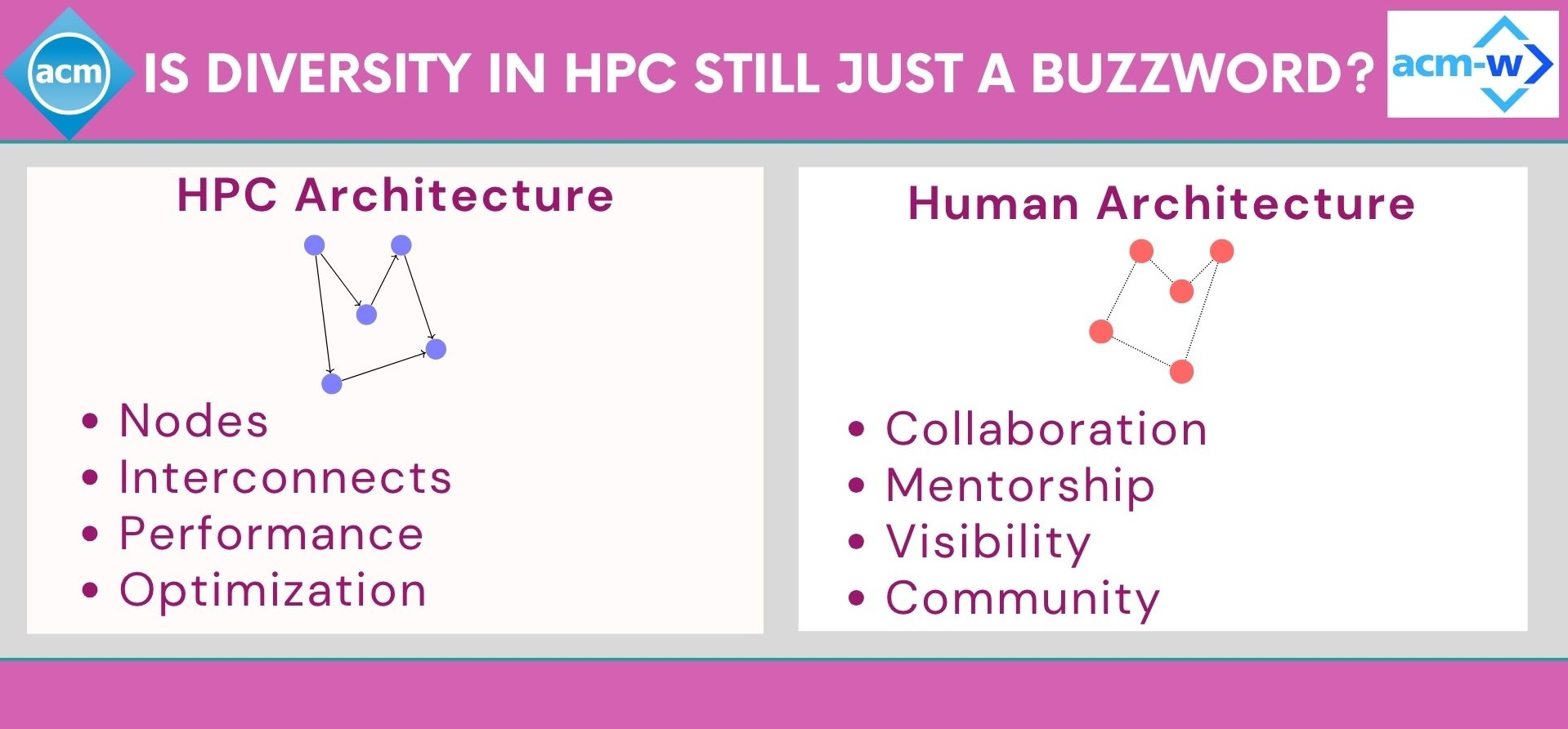
HPC systems are built on precision — distributed architectures, optimised performance, carefully engineered for scale. But what happens when we apply that same rigorous systems thinking to the human communities behind the research?
In the first post of her new blog series “Research Spotlights in Computing,” Ayesha Afzal, researcher at NHR@FAU (Germany), draws a striking parallel between computational and community architectures. Disconnected nodes, invisible bottlenecks, uneven load balancing — the structural failures we would never tolerate in a computational system are quietly accepted as normal in academic and professional communities.
Her central argument: diversity is not a value layered onto a system. It behaves like performance — shaped by architecture, constrained by connectivity, and limited by design. Homogeneous systems saturate early; diversity-optimised ones keep expanding the solution space.
The fix, she argues, is not awareness or intent. It is engineering.
Cognitive Bias Series: When Ambiguity Works Against Women in Computing
By Yildiz Culcu
Sarah is a software engineer with four years of experience and fresh machine learning training. The ML project goes to her male colleague anyway. Sound familiar?
In the latest entry of the ACM-W Europe Cognitive Bias Series, this piece examines the ambiguity effect — the tendency to default to stereotypes when information is unclear. In computing careers, this bias quietly shapes who gets the innovative, career-defining projects and who gets the safe, predictable ones. Research across thousands of participants and multiple companies shows the pattern is consistent — and costly.
The good news: it is solvable. Not by asking women to prove themselves more, but by removing the ambiguity that lets bias in through the back door. Clear criteria, structured processes, and tracked decisions are enough to make the gap disappear.
Why the Stories We Tell Matter
The history of computing is often told through a handful of familiar names. But the field has always been shaped by a much broader community — researchers, engineers, educators, and innovators whose contributions quietly built the technologies we rely on today.
In this reflection, ACM-W Europe volunteer Toshna explores why sharing these stories matters beyond Women’s History Month, and what it means for the community when more voices are made visible. Visibility, she argues, is not just about recognition — it is about helping students and early-career professionals see a place for themselves in computing.
Through initiatives like the Trailblazers in Computing blog series, ACM-W Europe is working to build a more complete picture of the field — one story at a time.
Do you have a story to share? They would love to hear it.
???? Read the full piece and join the conversation.
Trailblazers in Computing: Wendy Hall

Before linking and navigating information became second nature on the web, Wendy Hall was already thinking about how people connect with knowledge digitally.
This month’s Trailblazers in Computing feature highlights the British computer scientist whose research into hypermedia systems helped lay conceptual foundations for how we navigate the web today. From co-developing Microcosm — an early hypermedia system that anticipated many features of the modern web — to shaping AI policy at international level, Hall’s career spans decades of influence across research, academia, and public life.
Regius Professor of Computer Science at the University of Southampton, Fellow of the Royal Society, the Royal Academy of Engineering, and the ACM — her story is a reminder that the digital world we navigate so effortlessly was built on years of ideas that came well before their time.
???? Read the full profile in the Trailblazers in Computing series
Announcements
ACM Awards and Advanced Grades of Membership Deadlines
Each year, ACM recognises its members’ outstanding achievements through awards covering a spectrum of professional and technological areas and different stages of professional development. To learn more about other awards, we recommend ACM President Cherri M. Pancake’s article, dispelling some common myths about ACM Awards and Honors in the Communications of the ACM, August 2019. One of the myths is that the ACM Awards never honour people working outside North America. Prof. Pancake writes that even though nothing would make ACM committees happier than to recognise the achievements of people from around the globe, there are very few nominations. Source: Dispelling Common Myths About ACM Awards and Honors
| Students | HPC Fellowships, Cutler-Bell Prize |
| Early Career | Hopper Award, ACM and SIG Dissertation Awards (recent graduates), SIG “rising star” awards; also Senior Member |
| Mid Career | ACM Prize in Computing; also Distinguished Member |
| Late Career | Turing Award, Distinguished Service Award; also Fellow |
| Area-Specific, typically Mid to Late Career | Thacker Award, Software System Award, Athena Lecturer, Newell Award, Lawler Award, Eckert-Mauchly Award, Kennedy Award, Bell Prize, Karlstrom Award, Kannellakis Award, Policy Award, SIAM/ACM Prize – plus dozens of awards from individual SIGS |
For SIG-specific Awards, please visit https://awards.acm.org/sig-awards.
For ACM Advanced Grades of Membership, please visit https://awards.acm.org/advanced-member-grades.
Thank you for joining us in recognising ACM Women’s accomplishments in Europe and ensuring they are nominated for ACM Awards they deserve.
ACM-W Europe Website https://acmweurope.acm.org
ACM-W Europe Blog https://acmweurope.acm.org/blog
ACM-W Europe Facebook https://www.facebook.com/acmweurope/
ACM-W Europe Website ACM-W Europe Blog Facebook X (@acmweurope) Linkedin